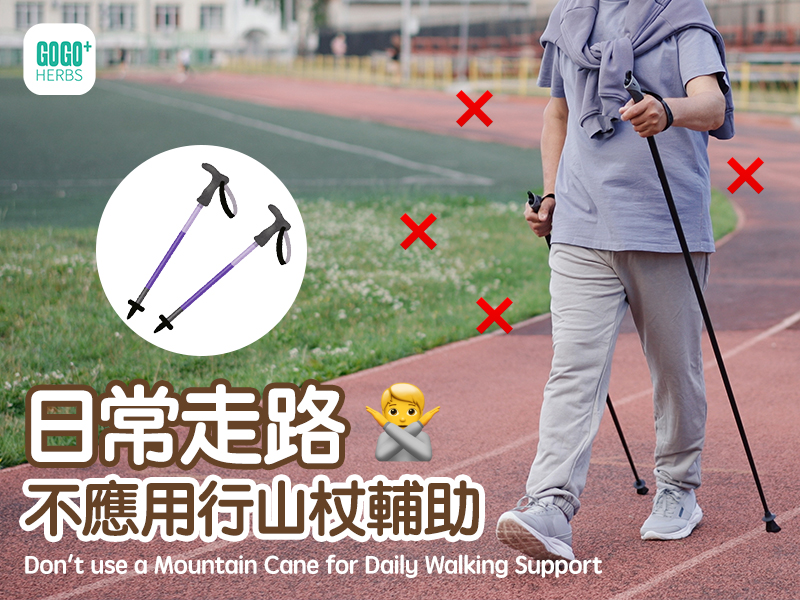
Many people believe that "any stick will do," so they use hiking poles or even long-handled umbrellas as everyday walking sticks. This is not ideal. The Consumer Council tested 30 walking sticks and 10 cane umbrellas on the market (Choice Monthly Issue 496) and found that more than 55% of the walking sticks failed all safety tests. The Consumer Council also clearly pointed out that...Long-handled umbrellas, walking stick umbrellas, and trekking poles are not suitable as walking aids.The primary function of a walking stick is to help the user maintain balance and distribute about 15% of the body's weight—a function that neither trekking poles nor umbrellas can do.
This article will first explain the functional differences between walking sticks and trekking poles, and why the elderly should not use trekking poles as a substitute for walking sticks. Then, it will use actual measurement data to illustrate the load on the knee joint when going up and down slopes. After that, it will organize when you need to use a walking stick, how to choose one (length, base, material, grip), the correct way to hold it and how to go up and down stairs, daily inspection and maintenance, and when you should first seek professional evaluation.
To summarize: Five things you can do
If you only want to remember a few things, these five will be most rewarding:
- Different equipment is used for daily walking and mountain hiking.For everyday walking, use a single-leg walking stick; trekking poles are designed for hiking, have fewer support points, and their bottom anti-slip design is generally not as good as that of a walking stick, making them unsuitable as a primary daily aid. The Consumer Council also lists trekking poles, walking stick umbrellas, and long-handled umbrellas as items unsuitable for walking assistance.
- Measure first, then buy.The height of the cane is based onThe first horizontal crease on the wrist extends to the ground.To determine the correct measurement, wear your usual shoes, stand upright, and let your arms hang naturally at your sides. Measurements that are too high or too low will negatively impact walking, balance, and posture.
- The base of the staff is the part that deserves the most attention.Choose a stick with soft rubber, moderate size, and an outer diameter wider than the inner diameter; replace the rubber pad once it is worn flat, worn, or cracked.
- Hold hands on the opposite sideIf one leg is weaker or more painful, the cane should be held in a more comfortable position.The opposite handIt should be on the same side, not the same side. This is where many people make a mistake in the very first step.
- Have it evaluated by professionals before buying.A physical therapist or occupational therapist can assess your gait, balance, and muscle strength, recommend appropriate types and heights of equipment, and teach you how to use them safely.
What are the functional differences between a walking stick and a trekking pole?
Both are "adding another fulcrum", but their design purposes are completely different.
Walking stick (an aid for everyday walking)Its main function is to provide additional support during walking: by using upper limb strength to assist the lower limbs in propelling the body forward, it improves stability while walking and also distributes the body's weight.15% of the weight(Explanation from the Consumer Council's test report). Its design prioritizes "stability" and "slip resistance," and it is usually equipped with a large, soft rubber sole.
Hiking polesIt is designed for rugged terrain and continuous ups and downs. Besides providing an extra point of support and improving balance, its main value lies in...Impact force on the lower limbs during walkingTrekking poles reduce the burden on the knees and legs, provide propulsion when climbing, and improve overall endurance. They are a very useful tool for hikers who need to go up and down hills for long periods of time or whose legs have uneven strength.
in other words:The strength of walking sticks is "stability", while the strength of trekking poles is "impact sharing and propulsion".Using trekking poles as everyday walking sticks is like using the wrong tool; conversely, using a single-legged trekking pole on a gravel trail is not necessarily ideal either.
Why should elderly people not use trekking poles for daily assistance?
Chiropractor and physical therapist Ho Ying-hui points out that the elderly should not replace their daily walking sticks with trekking poles because trekking poles...The support points are relatively insufficient.,andThe anti-slip design on the bottom is generally not as good as that of ordinary walking sticks.Improper use can actually increase the risk of falling.
This statement aligns with the Consumer Council's conclusion: After testing 40 walking sticks and cane umbrellas, the Consumer Council advised consumers to avoid using cane umbrellas as a substitute for walking sticks. Looking at all three (trekking poles, cane umbrellas, and long-handled umbrellas) together, their common problem is:If the walking stick has a small contact area at the tip or is designed for other purposes, its grip may not be sufficient on slippery indoor floors, shopping mall marble, or tile floors.
Cane umbrellas and long-handled umbrellas are both unsuitable.
Many people think, "Since I'm going to carry an umbrella anyway, I might as well buy a walking stick umbrella." However, the Consumer Council's 496th test results show that...Of the 10 walking stick umbrellas tested, 90% performed poorly.Some samples became permanently deformed after being loaded, and some samples had insufficient friction from the rubber pads at the tip of the cane. Cane umbrellas are also generally heavier (the Consumer Council tested cane umbrella samples weighing 405 to 618 grams, and cane samples weighing 217 to 525 grams). Holding the umbrella and bearing the weight with one hand simultaneously increases the burden on the wrist and shoulder. If necessary, a safer approach is to handle them separately: use a well-fitting cane and hold the lighter umbrella in the other hand.
Does using trekking poles while hiking really help with knee joints?
Yes, and there is actual measured data to support it—it's just that the original manuscript wasn't attached. Research in this area mainly focuses on...downhillThis is because going downhill is when the knee joint is under the highest load.
- Bohne and Abendroth-Smith (2007)Fifteen experienced male hikers were recruited to walk a 20-degree downhill slope at approximately 3 miles per hour, carrying backpacks of varying weights: 151 TP 4T (no backpack), 151 TP 4T (weight in kg), and 301 TP 4T (weight in kg). The results showed that when using trekking poles...The torque and power of the ankle, knee, and hip joints in the sagittal plane all decreased significantly.Moreover, this applies regardless of whether you are carrying a backpack or not.
- Schwameder et al. (1999)Similarly, observing downhill conditions revealed that using trekking poles can increase the peak ground reaction force, knee joint torque, and compressive and shear forces at the tibiofemoral joint.Reduced by approximately 12% to 25%。
- Willson et al. (2001)Measurements of walking on flat ground revealed that the use of trekking poles reduced the average vertical ground reaction force, knee joint compression force, and braking impulse; even at faster walking speeds, the lower limbs still experienced lower stress.
- Hawke and Jensen (2020)A review of literature from 1980 to 2019 concludes that using trekking poles can reduce the load on lower limb joints.The maximum is approximately 12% (vertical ground reaction force) and 16% (lower limb joint load).When carrying a heavy load, trekking poles can reduce lower limb muscle activity and improve balance and stability.
It is worth noting that the same review also points out that using trekking poles will...Increase cardiovascular load(Because it involves more upper limb involvement), so whether to adopt it depends on individual physical fitness and goals. Furthermore, some studies on Nordic walking have not observed a consistent load-reducing effect; some studies even measured a slight increase in knee joint load—this is related to the user's...Posture and TechniqueIt's very relevant. Overall, trekking poles are practical hiking equipment when properly guided and used correctly; related research is still ongoing.
How much pressure does the knee joint actually bear when going up or down a slope?
There's a common saying that "when going uphill, the knees bear three times your body weight, and when going downhill, they bear seven times your body weight." This combination of numbers...Not from a single authoritative source—In Chinese popular science articles, two versions are commonly used: "2/5/7 times" and "2/3/4 times." The "7 times" in the original source actually corresponds to...squat or jumpIt's not downhill.
Currently, the most reliable data comes from studies that measure forces directly on artificial knee implants (Kutzner et al., 2010; in vivo measurements of 5 subjects). The results are as follows:
| Activity | Knee joint stress (percentage of body weight) |
|---|---|
| Go down the stairs | Approximately 346% |
| Go up the stairs | Approximately 316% |
| Walking on flat ground | Approximately 261% |
| Standing on one leg | Approximately 259% |
| Knees | Approximately 253% |
| Stand up from a seated position | Approximately 246% |
| sit down | Approximately 225% |
| Stand on both feet | Approximately 1071 TP4T |
So the truth is:Walking on flat ground requires approximately 2.6 times body weight, climbing stairs requires approximately 3.2 times, and descending stairs requires approximately 3.5 times.The load on a downhill slope is indeed higher than on an uphill slope, but not as dramatically as "seven times." The key is not to memorize a single multiple, but to understand the trend:Downhill > Uphill > Flat landFurthermore, the load, pace, and body weight all contribute to these numbers. This is why trekking poles are most effective when going downhill—they transfer some of the load to the upper limbs and the poles.
If you already have knee pain, it's best to first determine the cause of the pain and how to maintain it daily before deciding on exercise methods and whether you need assistive devices. You can refer to the information on this site.Symptoms, causes, types, and daily care of joint pain〉One article.
In what situations should you consider using a cane?
A cane may be useful, usually related to balance, vision, or lower limb conditions. The following situations warrant discussion with a doctor or therapist (common bone and joint problems in the elderly can be found in the website <...>).Five Common Bone Problems in the Elderly〉):
- Poor balanceThey need to rely on supports to maintain their balance, or they have a feeling of "about to fall" when walking;
- Poor eyesightExtending the cane forward can provide an early warning when it touches an obstacle, allowing you to detect elevation differences earlier than relying solely on your eyes.
- Suffering from arthritisJoint pain or instability when walking;
- He had a strokeOne side of the body has weaker strength or coordination;
- Severe osteoporosisFalls carry a higher risk of fractures; assistive devices can reduce the chance of loss of balance (for details on the causes, diagnosis, and bone-protecting nutrition of osteoporosis, please see the relevant section on this website).Prevention and treatment of osteoporosis〉)。
These situations are quite common in Hong Kong. Data from the Department of Health can provide some background: among elderly people aged 65 and above who live in the community,Approximately one in five people falls each year.Among those who fell, about 75% will cause injury.A survey by the Department of Health also showed that falls are the most common unintentional injury, accounting for approximately 391 TP4T of all injury incidents. By age group, falls accounted for 61.81 TP4T of injury incidents among those aged 65 to 74, and a staggering 88.61 TP4T for those aged 75 or above. Data from elderly health services also indicated that elderly people who have fallen are approximately four times more likely to fall again than those who have never fallen.
Among the measures to prevent falls, the Department of Health explicitly includes "Use walking aids appropriatelyIt is listed alongside exercise and home environment improvement. In other words, using a well-fitting and safe walking stick is an officially justified practice—the key is "suitability" and "correct use".
How to choose a suitable walking stick for the elderly?
Length: Measure the first horizontal crease of the wrist, not just the "20-degree bend at the elbow".
The most commonly used measurement method is:Wearing my usual shoesStand on flat ground with your arms hanging naturally at your sides and your elbows slightly bent, and measure...The distance from the first horizontal crease on the inside of the wrist to the ground.This height is the ideal length for a cane. The UK's NHS Supply Chain and the British Medical Device Association (BHTA, accredited by the Chartered Physiotherapy Society) have designated the "first wrist crease" as the standard measurement point; at this point, the elbow will naturally bend slightly to about 15 to 30 degrees, which is just enough to apply downward force and allow the cane to share some of the weight.
Using the wrong height will have obvious consequences:The cane is too highThe shoulders will be pushed up, and the weight will be shifted to the wrists, neck and shoulders, which can easily cause soreness and make it difficult for the body to move naturally.The cane is too lowIf you bend over or turn to the side, you will have to bend over, which can easily lead to back pain and poor posture over time. Moreover, the center of gravity shifts forward, making it easier to fall.
The rubber pads on the bottom of the cane: most easily overlooked, yet most affecting safety.
The sole (rubber pad) is the only point of contact between the cane and the ground; its grip is equivalent to your safety margin. Key points for selection:
- MaterialChoose soft rubber, which can adapt to the ground and is not easy to slip; rubber mats that are too hard have poor grip on wet and slippery tiles.
- Volume and outer diameterThe outer diameter of the contact area with the ground should be wider than the inner diameter (the Consumer Council's standard is at least 10 mm wider). If the area is too small, the grounding will be insufficient.
- pittingIt must have obvious pits (the Consumer Council's standard is a depth of not less than 2 mm), and it must be replaced if the pits are worn smooth.
- metal gasketSome rubber pads have built-in metal gaskets, which can slow down the wear-through process.
Material and weight: How to choose between aluminum alloy and carbon fiber?
In principle, selectLightweight, sturdy, and not easily brokenThe most common type of material is...aluminum alloyAdjustable length, durable, and relatively affordable; higher-end products will use...carbon fiberLighter and with less vibration, but more expensive, and potentially brittle under extreme stress. The Consumer Council tested 30 cane samples ranging in weight from 217 to 525 grams—too heavy can cause wrist and shoulder fatigue, while too light may indicate thinner materials; it's best to try them out in person. Additionally, adjustable length models are generally more convenient than fixed lengths; after adjustment, remember to ensure the spring pin is fully extended and locked.
Grip: Should not be too small; T-shaped and crank handles each have their uses.
The grip is another often overlooked detail. If the grip is too small, older people have to exert more force to grip it, which can easily lead to strain; an additional grip could be added.Anti-slip handle coverReduce slippery surfaces. As for the shape:T-gripIt is well-suited for daily walking, making it easy to apply downward force with the entire palm;Crank (C-type) gripIt has an attractive design and distributes weight well to the forearm, but if the inner diameter of the handle is too small, people with larger hands may find it difficult to grip it securely. Most importantly...Try it out yourselfMake sure it feels comfortable to hold and doesn't slip.
One-legged, three-legged, or four-legged?
Single-legged walking sticks are the lightest, most versatile, and best suited for everyday walking. There are also models on the market with three or four claw-shaped legs at the base.With a large grounding area and the ability to stand firmly on its own, its stability is indeed quite high.Suitable for users with sufficient hand strength who require more support; however, be aware of their...heavierOn uneven surfaces or stairs, extra feet can themselves become a tripping hazard. Therefore, "more feet are not necessarily better." The choice should be based on individual gait, physical fitness, and usage scenario, and consult a physical therapist or occupational therapist if necessary.
Consumer Council tests 40 walking sticks: Which parts are most likely to cause problems?
The Consumer Council tested 30 walking sticks and 10 walking stick umbrellas in the 496th issue of its monthly magazine "Choice," primarily referencing Taiwan's CNS standards. The results are as follows:
| Test Project | Standard requirements | Test Results |
|---|---|---|
| Overall safety performance | Passed all test items | Of the 30 walking sticks tested, 17 (over 55%) failed; of the 10 walking stick umbrellas tested, 90% performed poorly. |
| Static load (cane deformation) | Deformation under load must not exceed 12 mm. | Nine walking sticks (three folding and six non-folding) and eight walking stick umbrellas exceeded the limit, of which four walking stick umbrellas were permanently deformed. |
| Strength at the junction of the grip and the shaft | It must not loosen, deform, or be damaged when subjected to gravity. | 11 models are unsatisfactory and may loosen or break during use. |
| Overlapping part of telescopic sleeve | When adjusted to its longest setting, the diameter must not be less than 65 mm. | Five models are 10 to 25 millimeters shorter than the standard, affecting the stability of the cane. |
| The stick has a rubber pad on the bottom for anti-slip (friction). | Meets ISO standards | Eleven models failed to meet the standards due to poor anti-slip performance (seven of which were cane umbrellas). |
| Rubber pad grooves and outer diameter | The pit depth shall be no less than 2 mm; the outer diameter shall be at least 10 mm wider than the inner diameter. | Four of the walking stick umbrellas had insufficient outer diameter, and two of them also had insufficient rib depth. |
| Rubber pad wear resistance | The lower the wear after 40 meters of friction, the better. | The samples varied by nearly tenfold, ranging from 75 to 702 cubic millimeters. |
This test yields several practical conclusions:1. Do not use "two-in-one" walking stick umbrellas for convenience.Its safety performance is the most inconsistent;Second, the walking stick is a "structural component".—A problem with any part of the cane, such as the shaft, the grip joint, or the telescopic sleeve, could cause it to fail when you need support the most.3. The rubber pads on the bottom of the cane are consumables.Its wear rate is faster than most people imagine, and it must be replaced regularly. The Consumer Council also advises consumers to try it out before purchasing to ensure that the length and weight are appropriate, choose models with a larger outer diameter rubber pad at the bottom, and check that the adjustment device is locked before use.
The correct way to use a cane
Buying the right walking stick is one thing, but using it correctly is another. Here are some common mistakes people make.
Which hand should you use to hold it? Hold it on the opposite side of the weaker leg.
If one side of the body is weaker or has pain (such as right knee pain, left-sided weakness after a stroke), the cane should be held on...The opposite handThis means "use your left hand to hold the weight when your right leg is weaker." This allows your body's center of gravity to naturally fall between the two points when walking, resulting in a more natural walking posture and less effort. If it's purely for balance and there's no significant difference between the two sides, you can hold the weight on the side that feels most comfortable to you, but it's still recommended to have a physical therapist assess your situation before deciding.
The cane should be used in sync with the weaker leg, not alongside the stronger leg.
The correct rhythm is:The cane and the weaker leg move forward simultaneously, then the better leg follows.Many people habitually extend their cane and good leg together, which causes the support point to be placed at the wrong time, greatly reducing its stability. Also, don't extend the cane too far forward or too sideways—the farther the cane is extended, the more effort you have to exert to support it, which actually increases instability. And don't carry the cane in mid-air while walking.
Going up and down stairs: "Good leg goes up, bad leg goes down."
- Go up the stairsIf there is no stable handrail, step up one level with your leg first, and then step up to the same level with your cane and the weaker leg.
- Go down the stairsFirst, place the staff and the weaker leg on the next level, and then the stronger leg can follow and step onto that level.
- Full processThe entire sole of the foot should be on the tread.Don't just use your forefoot; if there are handrails, hold on to them firmly, and it's better to go slowly than in a hurry.
- When getting up from a chair: first place the cane near the side of the chair, support yourself with both hands on the armrests to push your body up, and after you are steady, pick up the cane, pause for a moment before starting.
Routine inspection and maintenance
A walking stick isn't something you can buy and then forget about. It's recommended to check it against the following checklist periodically, or before each long trip:
- Cane base rubber padThis is the first thing to check. If the rubber pad is worn flat, slippery, the grooves are not obvious, or cracks appear, it should be replaced immediately.
- Adjustment device and jointCheck that the spring pin is fully extended and locked, that the sleeve is not loose, and that the screws are not loose. If any looseness is found, it should be dealt with or the screws replaced immediately.
- staff bodyCheck for cracks, dents, or bends. If any are found, stop using the product and replace it.
- cleanSimply wipe with a soft cloth; do not use cleaning agents. Also, do not store the cane in places where it will freeze (low temperatures will make the rubber brittle).
- WearingWear when using a caneFlat, supportive shoesHigh or unstable heels can affect balance.
In addition, maintaining good lifestyle habits—regular exercise, a balanced diet, not smoking, and avoiding alcohol—is just as important for bone strength and fall prevention. Related content can be found on this website.Develop good lifestyle habits to prevent bone loss>and<10 Healthy Foods for Seniors〉。
Frequently Asked Questions
Can trekking poles be used as everyday walking sticks?
Not recommended. Hiking poles have relatively fewer support points, and their bottom anti-slip design is generally not as good as that of regular walking sticks, even though they are designed for mountainous terrain. The Consumer Council also lists hiking poles, along with walking stick umbrellas and long-handled umbrellas, as unsuitable walking aids. For everyday walking, a single-leg walking stick is recommended; hiking poles should only be used for hiking, with each serving a specific purpose depending on the situation.
Can a walking stick umbrella (umbrella cane) replace a walking stick?
Not recommended. Of the 10 walking stick umbrellas tested by the Consumer Council, 90% performed poorly. Some samples permanently deformed after being loaded, while others had insufficient friction from the rubber pads at the tip of the stick. Moreover, walking stick umbrellas are generally quite heavy. If you need to both hold the umbrella and provide support, it would be safer to use a well-fitting walking stick with a lightweight umbrella.
How high should the cane be adjusted?
Wearing your usual shoes, stand on flat ground with your arms hanging naturally at your sides and elbows slightly bent, and measure...The first horizontal crease on the inside of the wrist extends to the ground.The distance should be such that the elbow is bent at approximately 15 to 30 degrees, allowing for downward force. Too high will put pressure on the shoulders, neck, and wrists; too low will require bending over, which can lead to back discomfort in the long run and increase the risk of falls.
Should you hold the cane with your left or right hand?
When one leg is weaker or more painful, hold the cane onThe opposite hand(Use your left hand if your right leg is weaker). When walking, move the cane forward simultaneously with the weaker leg. If it's just for balance and the difference between the two sides is not significant, hold the cane on the side that feels most comfortable, and have it confirmed by a therapist after assessment.
Are three- or four-legged walking sticks better than single-legged walking sticks?
Not necessarily. Three-legged and four-legged canes have a larger ground contact area and can stand on their own, making them more stable and suitable for users who need more support; however, they are also heavier, and on uneven surfaces or stairs, the extra supports themselves can become a tripping hazard. Single-legged canes are often more practical when hand strength is insufficient or when primarily used indoors.
How often should the rubber pads on the bottom of a walking stick be replaced?
There's no fixed time; it depends on wear and tear. Rubber pads are consumables; if they become flat, slippery, the grooves are less noticeable, or cracks appear, they should be replaced immediately. Consumer Council tests also show that the wear resistance of different rubber pads varies by nearly tenfold, so regular visual inspection is more practical than keeping a schedule. Replacement rubber pads can be purchased at most pharmacies or medical supply stores.
Is it better to use aluminum alloy or carbon fiber for a walking stick?
Aluminum alloy is more durable, adjustable, and relatively affordable, making it a practical choice; carbon fiber is lighter and vibrates less, but is more expensive. Regardless of which one you choose, the key point is...Lightweight, sturdy, and not easily brokenAnd try it out yourself to confirm that the weight and grip feel are suitable for you.
Will elderly people become more dependent on canes and experience muscle weakness if they use them?
As long as you continue walking and maintain your activity level, using assistive devices will not weaken your bones or muscles—a cane simply makes walking safer. What truly causes muscle weakness is…Reduce activity due to fear of falling.A walking stick can be seen as an aid to help seniors continue going out, shopping, and socializing. Combining it with appropriate strength and balance exercises (such as Tai Chi or seated leg raises) will enhance its effectiveness. For guidance on choosing the right type of exercise, please refer to the website's related information.The differences and benefits of aerobic and anaerobic exercise〉。
Can I still go hiking if I have knee problems? Should I use trekking poles?
Yes, but it depends on the severity and the advice of a doctor or physical therapist. The knee joint bears the most load downhill (approximately 3.5 times body weight in actual measurements). Trekking poles can transfer some of the load to the upper limbs. Studies show that knee joint torque and tibia-femoral stress can be reduced by approximately 12% to 25% downhill. It is recommended to shorten the route, reduce the load, slow downhill, and use trekking poles. If joint swelling and pain persist after hiking, consult a doctor for evaluation.
When should you see a physical therapist or occupational therapist?
If you or an elderly family member experience loss of balance, frequent near falls, need to hold onto a wall while walking, or suffer from arthritis, stroke sequelae, Parkinson's disease, or severe osteoporosis, it is recommended that you first be evaluated by a doctor or therapist. They can assess your gait and balance, recommend appropriate types and heights of assistive devices, take your measurements themselves, and teach you how to use them correctly. The UK NHS also explicitly recommends that assistive devices be matched and fitted by a physiotherapist or occupational therapist according to individual needs for optimal results.
In what situations should you see a doctor or occupational therapist first?
A cane is an assistive tool and cannot replace diagnosis. Professional evaluation is recommended in the following situations:
- Significantly worsened balance, had fallen or nearly fallenIt is advisable to see a family doctor as soon as possible and arrange for a physical therapist or occupational therapist to assess the risk of falls and gait.
- Suffering from arthritis, post-stroke sequelae, Parkinson's disease, severe osteoporosis, visual impairment, or foot problemsThese conditions can affect gait and balance. Walking aids should be selected and adjusted according to individual circumstances, and should not be purchased on one's own.
- I bought a walking stick but I'm not used to it.A cane that is too high or too low can impair walking, balance, and posture; it is advisable to have it remeasured by a professional.
- If any of the following symptoms occur after a fall, seek immediate medical attention or call 999.Symptoms of a fall include: head injury or altered consciousness, severe pain preventing standing, obvious limb deformities or inability to move, persistent vomiting, or visual changes. Even if an elderly person feels "okay" at the time of the fall, it is advisable to inform their family and monitor their condition for the next 24 to 48 hours.
In addition, if you experience significant weight loss in a short period of time, worsening weakness in your lower limbs, or persistent swelling and pain in your joints, you should first seek medical attention to find the cause before considering assistive devices.
Data Sources and Health Disclaimer
- Consumer Council.Cane Test Report(Selection Monthly Magazine, tests on the load-bearing capacity, structure, slip resistance, and labeling of 30 walking sticks and 10 walking stick umbrellas).
- Consumer Council.Choice Monthly Issue 496Table of Contents and Test Summary.
- Department of Health."Non-Communicable Diseases in Focus"—Elderly People Fall(Public health perspectives, global and local data, prevention recommendations).
- Department of Health."Non-Communicable Diseases in Focus"—Beware of Falls(Results of a local survey on unintentional injuries).
- Department of Health Elderly Health Services.Be careful to avoid falling.(Fall rate among the elderly, risk of relapse and health exercises).
- The Department of Health is leading a new direction for health.Non-infectious disease prevention tips: Be careful to avoid falls。
- The British Health Device Association (BHTA)Measuring a walking aid(Developed in collaboration with NHS Supply Chain and approved by the Chartered Institute of Physiotherapy in the UK, the measurement point is the first wrist crease).
- NHS inform.Moving around safely to help prevent falls(Pairing, height and maintenance of walking aids).
- NHS Fife.Using a walking stick(Measurement, calibration, inspection and maintenance).
- NHS Lanarkshire.Walking Aids – Walking Stick(Holding hand side, walking rhythm and going up and down stairs).
- NHS Lothian.How to use a walking stick(The order of going up and down stairs, and the proper way to stand up and sit down).
- Kutzner I, et al. Loading of the knee joint during activities of daily living measured in vivo in five subjects. Journal of Biomechanics 2010;43(11):2164-2173. PMID 20537336
- Bohne M, Abendroth-Smith J. Effects of hiking downhill using trekking poles while carrying external loads. Medicine & Science in Sports & Exercise 2007;39(1):177-183. PMID 17218900
- Hawke AL, Jensen RL. Are trekking poles helping or hindering your hiking experience? A review. Wilderness & Environmental Medicine 2020;31(4):482-488. PMID 32980249
- Chiropractor and physiotherapist Ho Ying-fai's explanation of the functions of canes and trekking poles, as well as precautions for the elderly, was quoted in a local media report.
Health Disclaimer:This article is for general health information purposes only and should not replace professional medical diagnosis, treatment, or individual rehabilitation advice. Everyone's physical condition, gait, and fall risk are different. Before choosing any walking aid, it is advisable to consult a doctor, physical therapist, or occupational therapist and select the appropriate type and height based on their assessment. If you or an elderly family member has ever fallen, experienced significant loss of balance, or suffered a head injury, altered consciousness, severe pain, or inability to stand after a fall, please seek medical attention immediately or call 999. The test data and research results cited in this article are measurements taken under specific conditions or with specific samples; actual results may vary depending on individual weight, walking speed, road surface, and the condition of the aid.
Related Products:
-
Sale!
![【門市低至$238】維柏健 - 健骨至尊 葡萄糖胺軟骨素膠囊 (500/400毫克) + D3 [特強配方] 300粒](https://gogoherbs.com/wp-content/uploads/2019/10/Glucosamine-3-1-300x300.png)
[Price as low as $238 in stores] Vepogen – Bone Strengthening Supreme Glucosamine Chondroitin Capsules (500/400 mg) + D3 [Extra Strong Formula] 300 capsules
Original price was: $298.00.$260.00Current price is: $260.00. Add to basket -
Sale!
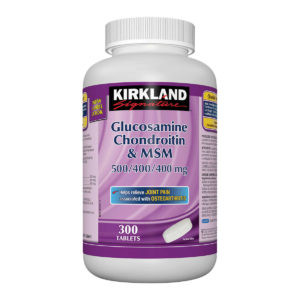
Kirkland Signature – Glucosamine & Chondroitin & MSM 500/400/400mg 300 Capsules
Original price was: $330.00.$258.00Current price is: $258.00. Add to basket -
Sale!
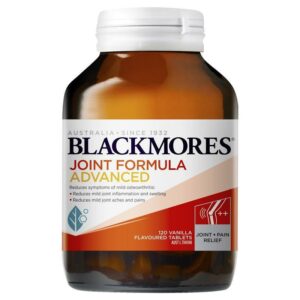
BLACKMORES – Joint Care Formula 120 capsules
Original price was: $258.00.$208.00Current price is: $208.00. Add to basket -
Sale!
![【平均$255/1】【門市低至$238】維柏健 - 健骨至尊 葡萄糖胺軟骨素膠囊 (500/400毫克) + D3 [特強配方] 300粒 x 3樽](https://gogoherbs.com/wp-content/uploads/2023/09/圖片_20260205165446_1856_1-300x300.jpg)
[Average $ 255/1] [Local price as low as $ 238] Vepogen – Bone Strengthening Supreme Glucosamine Chondroitin Capsules (500/400 mg) + D3 [Extra Strong Formula] 300 capsules x 3 bottles
Original price was: $894.00.$765.00Current price is: $765.00. Add to basket
Related Post:
![母親用滴管把少量植物藻油滴在食物匙上,幼兒坐在餐桌旁]()
A Complete Guide to Plant-Based Algae Oil Omega-3: Odorless, Vegetarian, and Suitable Omega-3 Choices for Pregnant Women and Infants
![牛樟芝子實體與膠囊製品示意]()
What is Antrodia camphorata? A complete guide to its ingredients, research evidence, and precautions for consumption.
![世界心臟日護心飲食場景,香港中年夫婦享用豆漿、豆腐、雞蛋與堅果,旁有心臟及細胞膜卡通示意]()
World Heart Day: Heart Health in Hong Kong Starts with Daily Life | What are the Benefits of Lecithin? Which of Three 1200mg Products to Choose From?
![香港關節健康洞察報告封面:中年及長者在香港步行]()
How to choose joint health supplements? 8 best-selling formulas and repurchase information help you find the right daily option.