
















































New technology from PolyU helps patients detect glaucoma early.
Hong Kong Polytechnic UniversityOphthalmology and OptometryThe college has developed a new technology for detecting glaucoma that can detect the disease 3 to 4 years earlier than traditional methods, facilitating early treatment and significantly reducing the chance of optic nerve necrosis. The technology has an accuracy of 95% and has been used in the college's ophthalmology clinic for six years, providing services to the public. Each examination costs approximately NT$2,000 to NT$3,000.
According to the World Health Organization, glaucoma is the second leading cause of blindness worldwide, after cataracts. However, currently used conventional diagnostic techniques (SAP) typically require patients to exhibit obvious symptoms, such as narrowed visual field, before an accurate diagnosis can be made. By then, the retinal ganglion cells have often already died by 251 TP4T to 351 TP4T. The new technology developed by the PolyU research team can detect glaucoma before the eye is severely damaged, identifying it 3 to 4 years earlier than traditional methods, with an accuracy of up to 951 TP4T.
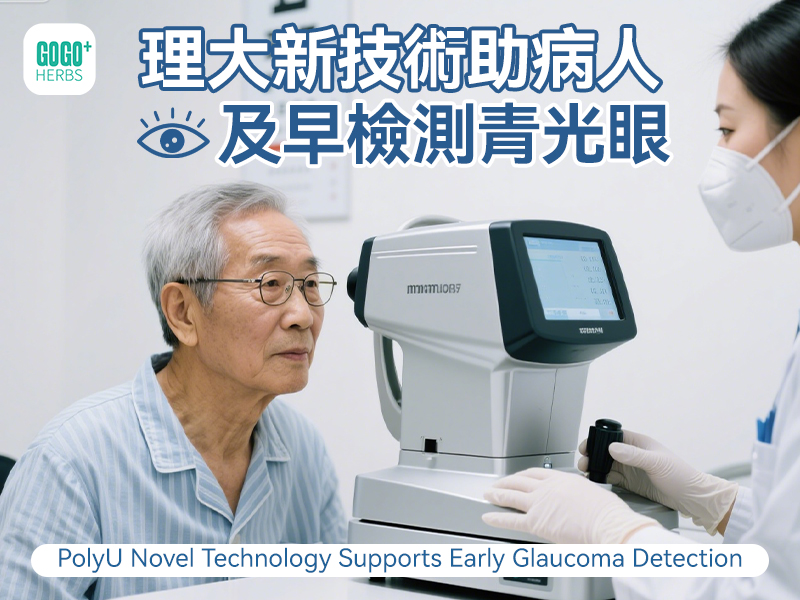
This technology was developed by a team led by Associate Professor Chen Haolong of the School of Ophthalmology and Optometry at PolyU. Professor Chen explained that during the examination, staff will first attach a testing device around the examinee's eyes, then ask the examinee to look at an electronic screen, taking short breaks every ten seconds or so. The entire examination takes about one hour. The new technology uses four different contrasting flashes to observe signal changes in various parts of the eye, thereby determining the risk of glaucoma.
Chen Haolong added that this technology was not entirely developed by the team, but rather a reintegration and optimization of existing technologies. They discovered that adjusting contrast could more accurately detect eye conditions. After completing research in 2012, the technology was put into service at the PolyU Eye and Optometry Clinic that same year, providing analysis results within approximately two hours of the test. However, he admitted that no medical institution has yet proactively contacted them to discuss collaboration.
Chen Haolong suggests that certain high-risk groups may consider using this technology for screening, including people aged 45 or older, those with a family history of glaucoma, those with high intraocular pressure, those who use steroids long-term, and those with diabetes.People with high myopia。
Dr. Pang Chiu-fai, a member of the Hong Kong Medical Association and an ophthalmologist, said he had heard of a new technology that could detect glaucoma earlier, which he considered a positive development for patients. However, the technology is not yet widely used, mainly because more large-scale clinical studies are needed to validate it. He pointed out that the medical community currently relies mainly on visual field testing and optical scanning to diagnose glaucoma, costing approximately HK$2,000 to HK$3,000.
According to the "2014-2015 Population Health Survey Report" published by the Centre for Health Protection, approximately 530,000 people in Hong Kong suffer from various types of eye diseases, of which 49,800 suffer from glaucoma, second only to patients with cataracts and other eye diseases.
The research findings from PolyU on early glaucoma detection technology will be showcased to the public in the form of exhibition boards at the "Innovation and Technology Carnival 2018" to be held at the Hong Kong Science Park from September 3 to 11.