
















































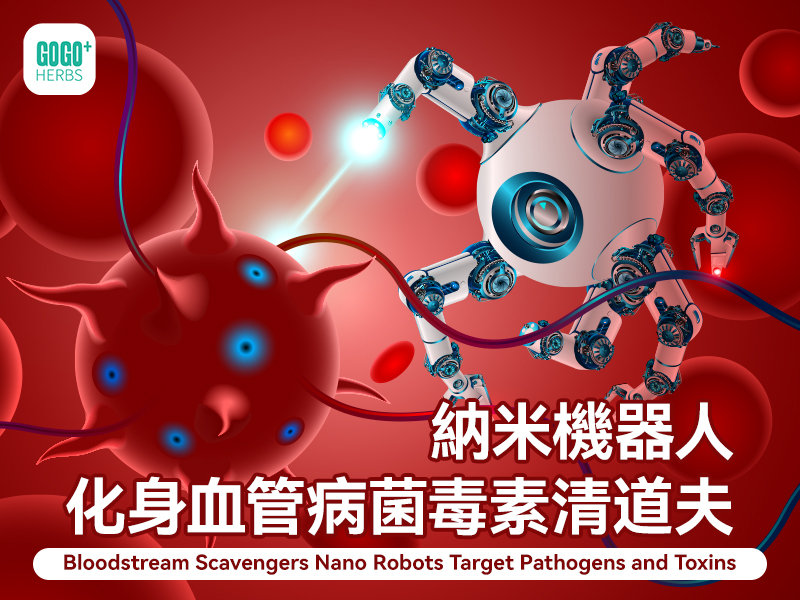
Nanorobots become scavengers of blood vessel bacteria and toxins
In the past, if people wanted to cleanse their bodiesIn blood vesselsTo combat germs and toxins in the body, we often rely on natural ingredients considered "detoxifying foods," such as honey, black fungus, kelp, green tea, mung beans, carrots, and garlic. However, in the future, a microscopic technological product—nano robots—may act as "scavengers" in the bloodstream, actively searching for and removing germs and their toxins, providing a more direct and efficient way to maintain health.
Nanorobots successfully remove superbugs from blood.
According to a recent research report published in the international journal *Science Robotics*, a nanorobot developed by a team at the University of California, San Diego, has successfully removed "superbugs" and their toxins from the bloodstream in a laboratory environment. This breakthrough offers new possibilities for the future treatment of bacterial infections.
This nanorobot is made primarily of gold nanowires, and its diameter is only 1/25th the size of a human hair—extremely tiny. The robot's surface is covered with a special hybrid cell membrane, formed by the combination of human platelets and red blood cells, mimicking the characteristics of natural cells. Driven by ultrasound, these nanorobots can move flexibly within blood vessels like normal cells, reaching speeds of up to 35 micrometers per second (equivalent to one millionth of a meter), and precisely bind to target bacteria.
Researchers tested blood samples contaminated with multidrug-resistant Staphylococcus aureus (commonly known as "superbugs"). The results showed that after just five minutes of treatment with a nanorobot, the concentration of bacteria and toxins in the blood samples decreased by approximately three times. If this technology is further developed, it holds promise for future applications in various viral or bacterial infections, enabling the development of broad-spectrum detoxification strategies. While the research is still in its early stages, its prospects are promising.
The broad application prospects of nanorobots in the medical field
In fact, nano-robotics technology has made significant progress in medical applications in recent years and is considered one of the important directions for future medical development. Its potential applications cover multiple areas such as drug delivery, cell repair, cancer treatment, immune regulation, and even medical monitoring, and it is expected to be widely used in clinical treatment in the future.
Especially in cancer treatment, nanorobots have shown revolutionary potential. Scientists have successfully developed a nanorobot loaded with anti-cancer drugs. After being injected into the human body via intravenous injection, these tiny robots can actively seek out cancer cells and precisely release drugs using their own navigation and propulsion capabilities, significantly improving treatment effectiveness while greatly reducing the side effects of chemotherapy on healthy cells, reducing the risks associated with invasive treatments, and significantly improving treatment efficiency and safety.
In addition, the nanorobots developed by Arizona State University in collaboration with the Chinese Academy of Sciences can deliver drugs directly to cancer cells within blood vessels and trigger reactions inside the tumor.thrombusThis process forms and blocks the oxygen and nutrient supply to the tumor, effectively inhibiting tumor growth. This technology has shown promising results in animal experiments with breast cancer, melanoma, lung cancer, and ovarian cancer, demonstrating its excellent application potential.
Even more noteworthy is the groundbreaking experiment conducted in May 2015 by a research team comprised of members from the University of Montreal, the Montreal Institute of Technology, and the San Justin University Medical Research Centre. They injected a "magnetic nanorobot" into the brains of mice and used a radio frequency field (RF field) to heat the nanoparticles and generate mechanical stress, temporarily opening the blood-brain barrier for approximately two hours, allowing drugs to enter the brain tissue. While this technology is not yet in human clinical trials, if it matures and is successfully applied in the future, it could potentially enable the treatment of brain tumors without surgery, significantly reducing surgical risks and complications.
In summary, nano-robotics technology is gradually moving from the laboratory to practical applications. In the future, it may not only play a key role in the treatment of infectious diseases, but also bring disruptive changes to the treatment of complex diseases such as cancer and brain diseases, bringing more possibilities to human health.





Author. gogoherbs
Related Products:
-
Sale!
 Out of stock
Webber Naturals – Triple Strength Omega-3 (900mg EPA / DHA) 200 capsules Value Pack
Original price was: $398.00.$280.00Current price is: $280.00. Add to basket -
Sale!

Kirkland Signature – Omega-3 Concentrated Deep Sea Fish Oil Pills 1300mg 330 Capsules
Original price was: $350.00.$298.00Current price is: $298.00. Add to basket -
Sale!

GNC – Triple Super Fish Oil Mini Capsules 240 Capsules
Original price was: $298.00.$245.00Current price is: $245.00. Add to basket -
Sale!

Swisse – Ultiboost Odorless High Concentration Wild Fish Oil 1500mg 400 Capsules
Original price was: $298.00.$220.00Current price is: $220.00. Add to basket