

















































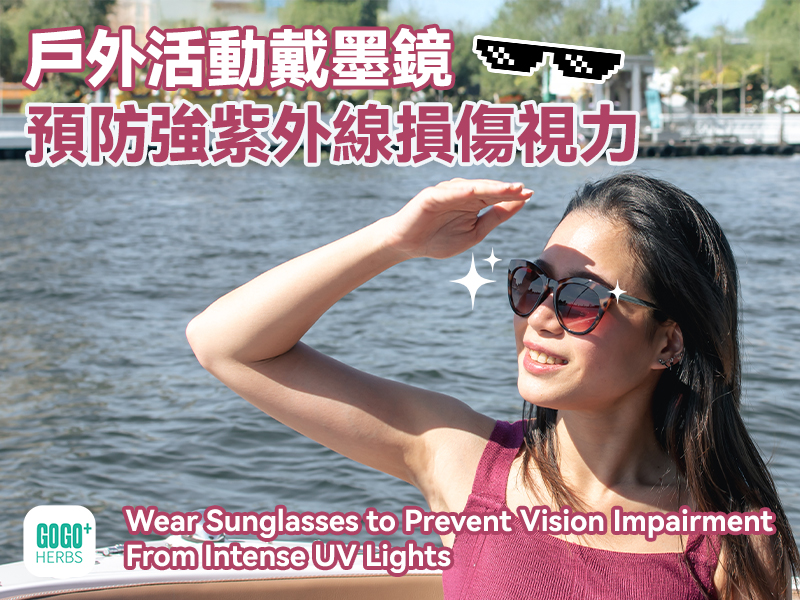
Wear sunglasses during outdoor activities to protect your eyesight from strong ultraviolet rays.
In the sweltering summer, many people enjoy basking in the sun. However, when engaging in activities under strong sunlight, in addition to taking basic sun protection measures, wearing a good quality pair of sunglasses is also quite important. Prolonged exposure of the eyes to ultraviolet rays may increase the risk of developing cataracts or even blindness.
The general public often mistakenly believes that the darker the tint of sunglasses, the better they block ultraviolet (UV) rays. However, ophthalmologists point out that the darkness of the lens tint is not directly related to its effectiveness in blocking UV rays. Doctors warn that using dark lenses that offer no UV protection may actually be harmful.Eye damage。
Ophthalmologist Yu Shan explained that ultraviolet (UV) radiation is part of solar radiation and exists not only outdoors but also indoors, such as under certain spotlights. Besides causing sunburn, UV radiation can affect eye tissues, including leading to problems like cataracts and macular degeneration. In severe cases, it can even cause macular hemorrhage, resulting in vision loss. Furthermore, prolonged sun exposure can cause conjunctival hyperplasia around the cornea, forming what's known as pterygium. Therefore, choosing sunglasses that effectively block UV rays is extremely important.
Sunglasses come in a variety of styles and lens colors, including gray, brown, blue, red, yellow, and even gradient shades, in varying shades. How should consumers choose? Yu Shan explains that the darkness of the lens color has nothing to do with its ability to block ultraviolet (UV) rays. Even ordinary clear lenses, if labeled "UV400," can block 100% of UV rays. Darker sunglasses primarily provide greater comfort in bright light; for everyday or indoor use, lighter lenses are recommended to avoid impaired vision in dim light.
Regarding lens color selection, Yu Shan believes gray and brown are ideal choices because these two colors can evenly filter different wavelengths of light, reducing chromatic aberration and minimizing visual impact. "Depending on individual work needs or driving conditions, there might be a slight impact." When engaging in water activities or skiing, since water and snow easily reflect ultraviolet rays, it is recommended to choose polarized lenses, which can effectively eliminate glare. The lenses should also be large enough and curved to reduce the chance of ultraviolet rays entering the eyes from the sides. However, polarized lenses may alter the image seen through computer or mobile phone screens, so they are not suitable for all situations.
Yu Shan also cautioned that the price of sunglasses is not directly related to their ability to block ultraviolet (UV) rays. Even sunglasses costing only a few tens of dollars may offer good UV protection. She suggested that people visit an optician to have their lenses tested using professional equipment to assess their UV-blocking capabilities. She emphasized that if sunglasses cannot effectively block UV rays, the pupils will naturally dilate when the light dims, potentially allowing more harmful light to enter the eyes and causing greater damage. Therefore, choosing the right sunglasses is crucial for effective UV protection.Protect eye health。