



























































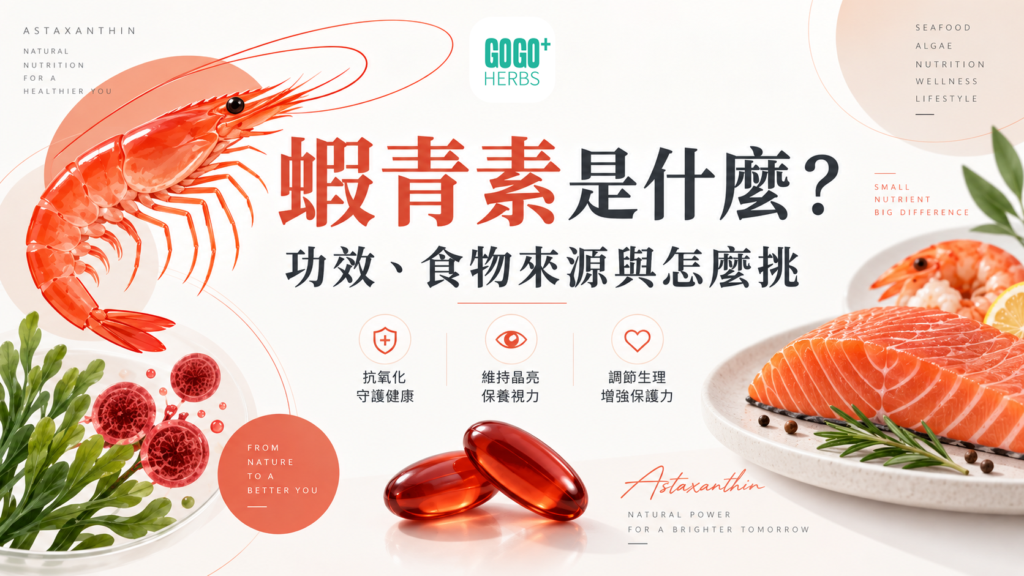
Astaxanthin is a name that has become increasingly common on health supplement shelves in recent years. It gives salmon its orange-red color, shrimp and crab their reddish hue after cooking, and flamingos their pinkish color—these colors are not decorative, but traces of the same natural pigment. It belongs to the carotenoid family, but it differs from other members in one key way: it is not converted into vitamin A in the body, nor is it a water-soluble pigment.
Based on official and academic sources, this article clarifies three things:What exactly is astaxanthin?、How should the sentence "Its antioxidant power is 500 times that of Vitamin E" be read?as well asTo what extent do existing studies support the two most concerning areas: skin hydration and screen-induced eye strain?The article also summarizes natural food sources, recommended daily doses and safety limits, as well as three key points to consider when choosing products, and situations where it is necessary to consult a doctor first.
2. How should we read "Its antioxidant power is 500 times that of Vitamin E"?
III. The effects of astaxanthin: What research says
IV. Natural Food Sources of Astaxanthin
5. How much should I eat each day? When should I eat?
VI. Upper limit of dosage and adverse reactions
VII. Safety Reminder: Who should consult a doctor first?
8. How to choose astaxanthin health supplements?
IX. Frequently Asked Questions (FAQ)
10. Sources of Information
I. What is astaxanthin? Let's first understand its identity.
Astaxanthin is aOxygenated carotenoids (also known as lutein)Chemically, it belongs to the "ketocarotenoid" family, with the full name 3,3′-dihydroxy-β,β-carotene-4,4′-dione. It is mainly synthesized in nature by microalgae.Haematococcus pluvialisUnder stressful conditions such as strong light and insufficient nutrition, astaxanthin accumulates in large quantities, turning the cells into red dormant cells for self-protection—which is also the main source of raw materials for current supplements.
Astaxanthin travels up the food chain: microalgae are consumed by krill, shrimp, and crabs, and then by salmon and trout, giving seafood its orange-red color. Humans previously obtained it primarily through seafood consumption, only recently developing it into concentrated supplements.
(1) Three key points that are easily confused
- It is not vitamin A:Among carotenoids, α-carotene, β-carotene, and β-cryptoxanthin can be converted into vitamin A in the body (called "provitamin A"); whileAstaxanthin, lutein, zeaxanthin, and lycopene are all "non-provitamin A" substances.It cannot be converted. Therefore, astaxanthin cannot be used as a source of vitamin A.
- It is fat-soluble, not water-soluble.Astaxanthin is insoluble in water and must be absorbed along with oils. This directly determines how it should be consumed (see Section 5).
- Its structure is very special:The molecule has a polar hydroxyl group and a ketone group at each end, with a long-chain polyene structure in the middle. This "polar at both ends and lipophilic in the middle" structure allows it to...lipid bilayer spanning the cell membrane—It exerts its antioxidant effects both in the inner layer and on the surface of the membrane. In contrast, β-carotene mainly functions inside the membrane, while vitamin C only functions in the aqueous phase.
(2) Do not confuse "carotenoids" with "anthocyanins".
Online sources often mention "three major types of carotenoids: lutein, astaxanthin, and anthocyanins."Actually, it's a classification error.Anthocyanins belong to the genus *Anthocyanin*.Flavonoids (polyphenols)It is a purplish-red, water-soluble pigment found in blueberries, purple sweet potatoes, and purple cabbage; it belongs to a different chemical family than carotenoids. The true carotenoids are lutein, zeaxanthin, beta-carotene, lycopene, and astaxanthin.
According to Oregon State University Compiled by Linus Pauling InstituteThere are more than 750 known carotenoids in nature, and about 40 to 50 of them are found in the human diet. The six most common ones are α-carotene, β-carotene, β-cryptoxanthin, lutein, zeaxanthin, and lycopene.
| ingredient | Is it a carotenoid? | Solubility | Can it be converted into Vitamin A? |
|---|---|---|---|
| Astaxanthin | Yes (oxygen-containing) | fat soluble | 否 |
| Lutein, Zeaxanthin | Yes (oxygen-containing) | fat soluble | 否 |
| beta-carotene | It is (carotene). | fat soluble | 是 |
| Lycopene | It is (carotene). | fat soluble | 否 |
| anthocyanin | No (belongs to flavonoids/polyphenols) | Water-soluble | 否 |
2. How should we read "Its antioxidant power is 500 times that of Vitamin E"?
You may have seen astaxanthin described as having "100 times, 500 times, or even 6000 times the antioxidant power of vitamin E, and vitamin C." These figures are not fabricated, but...These studies are based on activity comparisons under laboratory (test tube) conditions and cannot be used to directly infer their efficacy in humans after oral administration.There are three reasons:
- The numbers themselves are highly inconsistent:For the same ingredient, different experiments have yielded results of 100 times, 110 times, 500 times, and even 6000 times the increase. Since there is no fixed value, it means that it depends on the experimental conditions, rather than a constant that can be directly applied to the human body.
- The object of comparison is singlet oxygen:These multiples mostly compare the ability to quench singlet oxygen. The Linus Pauling Institute points out that carotenoids quench singlet oxygen...plantIt is very important, butThe link between singlet oxygen quenching and human health remains unclear.。
- Limited oral absorption:Ingested astaxanthin needs to be absorbed and transported before it reaches tissues, resulting in low bioavailability; the concentration in a test tube does not equal the concentration in the body.
A more pragmatic approach would be:Astaxanthin's transmembrane structure allows it to exert antioxidant effects both inside and outside the lipid membrane, which is why it is particularly noteworthy among carotenoids.However, to know whether it is actually effective, we need to look at human studies, not test tube studies. The next section summarizes the current status of human studies.
III. The effects of astaxanthin: What research says
Human studies on astaxanthin have focused on two directions:skin與Eye strain (especially from screen time)The following is a summary of the research findings, including both supporting and reserved points.
(1) Skin: Moisture retention and elasticity are the most supported aspects.
This is where the most research on astaxanthin has been accumulated, and there has been a comprehensive analysis:
- A study published in *Nutrients* in 2021, which included eight randomized controlled trials,Integral analysisThe results show that oral astaxanthin can...Significantly increases skin hydration(Standardized mean deviation 0.53) andImprove skin elasticity(Standardized mean deviation 0.77); As forThe depth of wrinkles did not reach statistical significance.。
- A study that included 11 clinical trials in 2020Systematic ReviewIt was also noted that astaxanthin (approximately 3 to 6 mg daily) helps improve skin texture, appearance, and hydration, and shows a protective effect against UV-induced skin damage; no serious adverse events were reported in the study.
- Other smaller studies include: 6 or 12 mg daily for 16 consecutive weeks resulted in better changes in wrinkle and moisture levels than the placebo group; 4 mg daily for approximately 9 to 10 weeks increased the skin's "sunburn threshold" and reduced moisture loss.
① The sample sizes of the above studies are generally small, and the subjects are mainly healthy adult women.Moreover, many of them are funded by raw material or product manufacturers.When interpreting this, it should be viewed conservatively and not regarded as a definitive conclusion.
② Astaxanthin is not an "oral sunscreen".It may slightly increase the skin's tolerance to ultraviolet rays, butIt cannot replace sunscreen, clothing, and sun protection.It is a common misconception to consider oral antioxidants as an alternative to sun protection.
(2) Eyes: Screen fatigue and accommodation
"Screen fatigue" (eye strain and difficulty focusing after using computers and mobile phones) is the most frequently cited area for astaxanthin, and it is supported by several double-blind controlled studies, although the scale is generally small.
- According to a 2020 articleEye Application ReviewMultiple double-blind randomized studies involving VDT (video-visual-constant) workers have shown that astaxanthin supplementation (commonly 6 mg daily for 4 weeks) resulted in...The eye's accommodative ability and symptoms of perceived fatigue have improved.。
- OneDouble-blind placebo-controlled study in 2023Sixty healthy adults were given a daily supplement of 9 mg for six weeks. Results...Group of 40 years and olderIt provides better protection for corrected vision after screen work;No difference was observed in the under-40 age group.There were no differences in functional visual acuity and pupillary contraction rate between the two groups. This study was funded by the raw material manufacturer and is a matter of disclosure of interest.
- Regarding children, a study involving 10 to 14-year-olds with mild to moderate computer vision syndrome (daily supplementation, 84 days) showed...Visual fatigue-related indicators and stereoscopic vision improved.However, no differences were observed in visual acuity, refractive error, or accommodation parameters, and no adverse events were reported.
- Regarding eye diseases, existing data mostly classify them as...Compound StudyFor example, a study involving 27 patients with early-stage dry age-related macular degeneration used a compound containing 4 mg of astaxanthin, lutein, zeaxanthin, vitamins C/E, zinc, and copper. After 12 months, central retinal function indicators improved; however, because it was a compound,The effect cannot be attributed solely to astaxanthin.。
(3) Cardiovascular and exercise: a research direction that is still accumulating
Astaxanthin has also been studied in the cardiovascular and exercise fields. Some studies have observed positive effects on blood lipid indicators such as triglycerides and high-density lipoprotein (HDL), while others have focused on oxidative stress indicators after exercise; however...The dosage, subjects, and measurement indicators varied considerably among different studies, and the conclusions were not yet consistent, indicating a direction in which evidence continues to accumulate.If the goal is cardiovascular health, a balanced diet, regular exercise, and treatment recommended by a doctor remain the mainstays.
IV. Natural Food Sources of Astaxanthin
In our daily diet, astaxanthin almost entirely comes from seafood. The following are common reference values; actual levels will vary depending on the species, growing environment, and feed:
| food | Reference content | illustrate |
|---|---|---|
| Wild sockeye salmon | Approximately 4.5 mg/100g | Foods with high content |
| wild rainbow trout | Approximately 5.5 mg/100g | Content comparable to that of salmon |
| Arctic shrimp | Approximately 1.2 mg/100g | Eating shrimp shells along with the shrimp increases the intake of nutrients. |
| lobster | Approximately 1.0 mg/100 g | The pigments are mainly concentrated in the shrimp shell. |
| Krill, other shrimp and crab, trout | Content varies depending on the variety. | It is also one of the food sources |
- A serving of 200 grams of salmonIt provides approximately 1 to 7 milligrams of astaxanthin (approximately 3 to 37 milligrams per kilogram of fish), depending on the source.
- ⚠️ The orange-red color of farmed salmon comes from feed additives.(Natural algal source or synthetic astaxanthin), so the content depends on the feed formula and may not be the same as that of wild astaxanthin.
- Main ingredients of supplementsIt is Haematococcus pluvialis; krill oil is another secondary source.
- Real-world reminder:If you don't eat seafood regularly, it's difficult to reach the dosage used in the study through your daily diet alone—which is why many people choose concentrated supplements.
- In terms of cooking:Astaxanthin is relatively stable and is generally not significantly affected by heating; the real key is...That meal needs to contain oil.(See next section).
5. How much should I eat each day? When should I eat?
- Commonly used dosage in research:Most eye and skin studies use4 to 6 mg dailySome skin studies used 12 mg. The general health maintenance range is 4 to 12 mg daily.
- Take with meals, and it should contain oils:Astaxanthin is fat-soluble; according to the Linus Pauling Institute, as long as it is present in about [amount missing] in a meal... 3 to 5 grams of fatThis is sufficient to aid in the absorption of carotenoids. Absorption will be significantly worse when taken on an empty stomach or with a low-fat meal.
- Dosage form differs:Oil-based soft capsules (or those formulated with edible oils) generally have better bioavailability than dry powder tablets.
- It takes time to accumulate:Most studies show changes only after 4 to 12 weeks. It is recommended to...8 to 12 weeksAs this is an observation period, it is not advisable to expect immediate results.
- Morning or evening is fine:Current evidence does not show a significant difference between morning and evening; the key is to take it regularly with a meal containing oil.
VI. Upper limit of dosage and adverse reactions
Astaxanthin has a good overall safety record, but there are still dosage reference values and a few precautions:
| mechanism | Reference value | illustrate |
|---|---|---|
| European Food Safety Authority (EFSA, 2020) | The acceptable daily intake is 0.2 mg/kg body weight. | For a 70 kg adult, the dosage is approximately 14 mg; a daily intake of 8 mg from supplements is safe for adults and adolescents aged 14 and older.Not suitable for children under 14 years old(Including food intake, the value may exceed the reference range) |
| US FDA | The maximum daily dose is 12 mg; for short-term use (not exceeding 30 days), it can be up to 24 mg. | Astaxanthin derived from Haematococcus pluvialis |
- Tolerance during the study:A single dose of 40 mg, and daily doses of 16 to 40 mg (for patients with functional dyspepsia), were well tolerated in studies; however, these doses are not general recommendations and should not be used for self-comparison.
- Benign reactions that may occur with higher doses:Continuing to consume more than 20 mg daily may cause a yellowish-orange skin tint (carotenemia) in a small number of individuals.ReversibleThe symptoms will return after reducing the dosage or stopping use; pink or red stools and mild gastrointestinal discomfort may also occur, usually related to taking it on an empty stomach.
- Pregnancy and breastfeeding:Currently, there is a lack of sufficient human safety data, generallyNot recommendedTaking concentrated supplements during these two stages; consuming small amounts from foods such as salmon and shrimp is within the scope of a normal diet.
VII. Safety Reminder: Who should consult a doctor first?
It is also recommended to consult a doctor or pharmacist in the following situations:
- About to undergo surgery or dental surgery:Due to the risk of bleeding, it is generally recommended to discontinue use at least two weeks in advance. Please follow the instructions of your medical staff for specific arrangements.
- Pregnant women and breastfeeding mothers:There is a lack of data on human safety.
- Children under 14 years old:According to EFSA's assessment, the supplement dosage may exceed the reference value, and its use is generally not recommended.
- For those allergic to algae or seafood:Pay attention to the source of raw materials and production line, and carefully read the label before purchasing.
- For those currently taking other long-term prescription medications or suffering from chronic illnesses:Let your doctor know what supplements you are taking.
When should you seek medical attention as soon as possible?Sudden vision loss, straight lines appearing curved, blackouts or flashes of light in front of the eyes, red and painful eyes, and visual field defects—these are not conditions that can be treated with supplements, and you should see an ophthalmologist as soon as possible.
8. How to choose astaxanthin health supplements?
There is a significant difference between astaxanthin products on the market. The following three points are the most practical criteria for judgment:
- ① Check if the source of the raw materials is specified as "Haematococcus pluvialis".All human studies use astaxanthin derived from natural algae. Astaxanthin synthesized from petrochemical raw materials has a different stereoisomer ratio than natural astaxanthin and is mainly used in aquatic feed; it is not approved for human consumption in most regions. Labels that only state "astaxanthin complex" without specifying the source make it difficult to determine its origin.
- ② Check the actual content (mg) of each pill.The commonly used range in studies is 4 to 12 mg daily. If the product is a combination product, it is important to confirm the exact amount of astaxanthin in milligrams, rather than just looking at the large number in the "total extract".
- ③ Check the dosage form and packaging method.Fat-soluble ingredients are better absorbed in oil-based soft capsules or formulations with oil carriers; in addition, pay attention to whether there are third-party inspection or batch reports, and whether the capsule itself is gelatin (vegetarians need to check this in special way).
IX. Frequently Asked Questions (FAQ)
Q1: Is astaxanthin a type of vitamin A?
No. Astaxanthin is a carotenoid, but it is a "non-provitamin A," meaning the human body cannot convert it into vitamin A. Vitamin A should be obtained from animal liver, eggs, milk, or orange/dark green fruits and vegetables rich in beta-carotene.
Q2: What is the difference between astaxanthin and lutein? Which one should I choose?
Both are carotenoids and fat-soluble, but they have different functions: lutein selectively accumulates in the macula of the eye, and research mainly focuses on its relationship with macular health and blue light filtering; astaxanthin does not concentrate in the macula and is more often studied in relation to screen fatigue, accommodation, and skin hydration. They are...A pairing relationship, not an either/or choice.Many eye care formulas contain both (the formula described on this page is one example).
Q3: Are anthocyanins also carotenoids?
No. Anthocyanins belong to the flavonoid family (polyphenols), and are the purplish-red, water-soluble pigments found in blueberries, purple sweet potatoes, and purple cabbage. They belong to a different family than carotenoids. Both may be related to eye health, but their chemical properties and absorption methods are different (for example, anthocyanins do not require lipids for absorption).
Q4: Can I skip sunscreen if I take astaxanthin?
No. Astaxanthin is not a sunscreen ingredient. It may slightly increase the skin's tolerance to ultraviolet rays, but it cannot replace sunscreen, clothing, or sun protection. Sunscreen remains the most basic step in protecting your skin.
Q5: How long does it take to see results?
Most studies lasted 4 to 12 weeks, and this is a nutrient that needs to be accumulated. It is recommended to use an 8 to 12-week observation period and take it with a meal containing fat every day; taking it for a few days in a short period usually will not show obvious changes.
Q6: Can vegetarians consume astaxanthin?
Astaxanthin itself comes from microalgae and is not of animal origin; however, many commercially available capsules have gelatin (animal-derived) shells. Vegetarians can look for products labeled as plant-based capsules (such as hydroxypropyl methylcellulose).
Q7: Can astaxanthin be taken with fish oil or lutein?
Yes, all three are fat-soluble, so taking them together with meals helps with absorption and they won't interfere with each other. However, if you are taking prescription medications (especially anticoagulants), you should still consult your doctor or pharmacist first.
10. Sources of Information
- Linus Pauling Institute (Oregon State University):Carotenoids(Types of carotenoids, classification of provitamin A, fat solubility and absorption conditions)
- Zhou X, et al. Systematic Review and Meta-Analysis on the Effects of Astaxanthin on Human Skin Aging. Nutrients. 2021;13(9):2917. full text
- Ng QX, et al. Effects of Astaxanthin Supplementation on Skin Health: A Systematic Review of Clinical Studies. J Diet Suppl. 2020. summary
- Giannaccare G, et al. Clinical Applications of Astaxanthin in the Treatment of Ocular Diseases: Emerging Insights. Mar Drugs. 2020;18(5):239. full text
- Sekikawa T, et al. Effects of diet containing astaxanthin on visual function in healthy individuals: a randomized, double-blind, placebo-controlled, parallel study. J Clin Biochem Nutr. 2023. summary
- Santiyanon N, Yeephu S. Interaction between warfarin and astaxanthin: A case report. 2019. full text
- Davinelli S, et al. Astaxanthin in Skin Health, Repair, and Disease: A Comprehensive Review. Nutrients. 2018;10(4):522. full text(Safety information, FDA daily recommended limits)
- EFSA Panel on Nutrition, Novel Foods and Food Allergens (NDA). Safety of astaxanthin for its use as a novel food in food supplements. EFSA Journal. 2020;18(2):5993. Full text of the opinion
- A systematic review of Nutrients (2025):Nutritional Supplementation for Myopia Prevention and Control(Including research on astaxanthin in children with computer vision syndrome)full text
- NHS:Dry eyes (daily care and medical advice for dry eyes)
Disclaimer:This article shares general nutrition and health knowledge.This does not constitute any diagnosis, treatment, or prescription advice, nor can it replace professional medical advice.The studies mentioned in this article are based on specific conditions; individual circumstances vary, and results may differ from person to person. Astaxanthin and other supplements are intended as daily nutritional aids and cannot replace a balanced diet, sun protection, eye examinations, or doctor's prescriptions. Pregnant women, breastfeeding mothers, children under 14 years of age, those taking prescription medications (especially anticoagulants), those with bleeding disorders, or those about to undergo surgery should consult a doctor or pharmacist before use. If persistent discomfort or vision abnormalities occur, please seek medical attention as soon as possible. Product ingredients, content per capsule, recommended dosage, and precautions are subject to the information displayed on the packaging and the latest information on the product page at the time of purchase.
Related Post:
![母親用滴管把少量植物藻油滴在食物匙上,幼兒坐在餐桌旁]()
A Complete Guide to Plant-Based Algae Oil Omega-3: Odorless, Vegetarian, and Suitable Omega-3 Choices for Pregnant Women and Infants
![牛樟芝子實體與膠囊製品示意]()
What is Antrodia camphorata? A complete guide to its ingredients, research evidence, and precautions for consumption.
![世界心臟日護心飲食場景,香港中年夫婦享用豆漿、豆腐、雞蛋與堅果,旁有心臟及細胞膜卡通示意]()
World Heart Day: Heart Health in Hong Kong Starts with Daily Life | What are the Benefits of Lecithin? Which of Three 1200mg Products to Choose From?
![香港成年人在家閱讀與休息,從日常習慣開始理解腦部健康]()
Fish oil, mini capsules, or B12? Formulas and daily choices for 8 best-selling brain health products.