


















































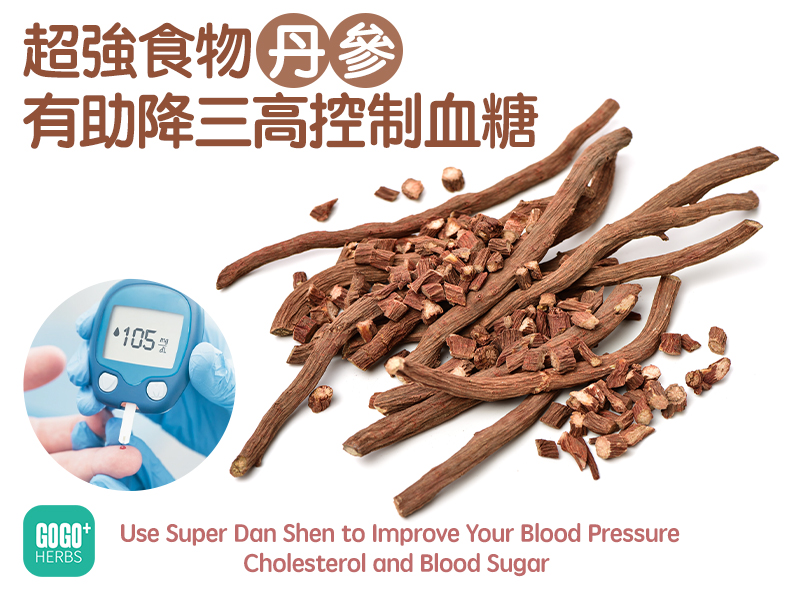
Salvia Miltiorrhiza, a super food, helps to lower blood glucose levels
In recent years, the Chinese medicinal herb Danshen has sparked much discussion on online communities. This brownish-red rhizome is not only a commonly used traditional Chinese medicine, but also has demonstrated diverse health benefits through modern scientific research. It plays a unique role in everything from cardiovascular health care to beauty and skin care, and even weight loss and conditioning.
A natural remedy for promoting blood circulation and removing blood stasis to protect the heart
In Traditional Chinese Medicine (TCM), Danshen (Salvia miltiorrhiza) is classified as a blood-activating and stasis-removing herb. Modern medical experiments have confirmed that its active ingredients can inhibit abnormal platelet aggregation, reduce blood viscosity, and regulate the balance of the body's internal and external coagulation systems, showing significant effects in preventing and improving cardiovascular diseases. Dr. Chou Tsung-han, a TCM physician at the Renai Branch of Taipei City Hospital, points out that Danshen has auxiliary therapeutic effects on menstrual irregularities, amenorrhea, dysmenorrhea, injuries, acne swelling and pain, irritability, insomnia, and angina pectoris. Its conditioning effect is particularly prominent for microcirculatory disorders caused by "qi stagnation and blood stasis." He adds that because Danshen can promote blood circulation, it is often included in weight-loss tea formulas to help improve metabolic efficiency.
Scientifically proven key ingredients that help with weight loss and liver protection
A research team at Taipei Medical University discovered that ST32da, a single compound in Danshen (Salvia miltiorrhiza), has the potential to transform adipocytes—it can convert white adipose tissue (WAT), which easily accumulates calories, into brown adipose tissue (BAT), which is easier to burn. This not only helps with weight management but also improves fatty liver disease, inhibits liver inflammation markers, and alleviates the risk of obesity-related diabetes. In fact, Traditional Chinese Medicine has a long history of using Danshen to assist in weight loss, but clinical prescriptions often take the form of compound formulas: for patients with fatty liver, it is often combined with other Chinese herbs such as safflower, cassia seed, hawthorn, papaya, poria cocos, polygonatum odoratum, euryale ferox, lophatherum gracile, tangerine peel, cinnamon, and lily bulb to achieve a comprehensive effect.Lower blood pressureSynergistic effect of blood lipids and blood sugar.
Flexible application of topical beauty treatments and cardiovascular health care
The health benefits of danshen (Salvia miltiorrhiza) are not limited to internal consumption. For dark circles caused by staying up late, grinding danshen into powder, mixing it with pearl powder and moisturizing lotion, and applying it around the eyes can improve microcirculation and reduce pigmentation and puffiness. For maintenance...Cardiovascular healthTo achieve this goal, Zhou Zonghan suggests combining Danshen (a type of medicinal herb) with tea: high-quality tea itself has the effects of clearing heat and aiding digestion, as well as promoting urination and detoxification; the theophylline in it can dilate blood vessels...Strengthen capillary elasticityIn synergy with Danshen (Salvia miltiorrhiza), this tea can effectively lower cholesterol and improve symptoms of coronary heart disease such as atherosclerosis and myocardial infarction. It is recommended to avoid drinking this tea before bedtime to prevent caffeine from affecting sleep quality.
Gentle conditioning options for women's health
Danshen (Salvia miltiorrhiza) also holds a place in the field of gynecology. Although there is a saying that "one dose of Danshen is as effective as Siwu Tang (Four-Substance Decoction)," its efficacy cannot completely replace the compound effects of Siwu Tang. In comparison, Danshen is safer and has the properties of promoting blood circulation and regulating menstruation, making it particularly suitable for women with dysmenorrhea caused by blood stasis. It is recommended to consume a qi-tonifying chicken soup with Danshen after menstruation to help relieve postmenstrual fatigue and dry mouth. Zhou Zonghan further explained that in addition to women with menstrual pain, elderly people with qi and blood deficiency, postpartum women who have not recovered from weakness, or those with anemia caused by malnutrition can all use Danshen to regulate their constitution.
[Chicken Soup Recipe for Nourishing Qi and Promoting Blood Circulation]
MaterialsIngredients: Half a free-range chicken (cut into pieces), 10g of Salvia miltiorrhiza, 10g of Astragalus membranaceus, 10g of Ophiopogon japonicus, 6g of Glycyrrhiza uralensis, 5 red dates, 3 slices of old ginger, 50cc of rice wine, and 3000cc of cold water.
Steps::
1.Prepare the ingredients: cut the chicken into pieces, and rinse the Chinese medicinal herbs quickly with water to remove dust.
2.Pre-cook to remove blood: Put the chicken in cold water (it must be completely submerged), add 3 slices of ginger, bring to a boil over high heat, then remove and rinse off any impurities.
3.Stewing a nourishing soup: Place the prepared chicken in a soup pot, add water to cover the ingredients, pour in rice wine, add all the Chinese medicinal herbs, bring to a boil over high heat, then simmer over low heat for about 40 minutes. Finally, add salt to taste before serving.
This soup combines the blood-activating effects of Salvia miltiorrhiza, the qi-tonifying effects of Astragalus membranaceus, and the yin-nourishing effects of Ophiopogon japonicus. It is suitable for people with weak qi and blood, postpartum recovery, or malnutrition to eat regularly. It is a health-preserving choice that combines traditional wisdom with modern needs.