



































































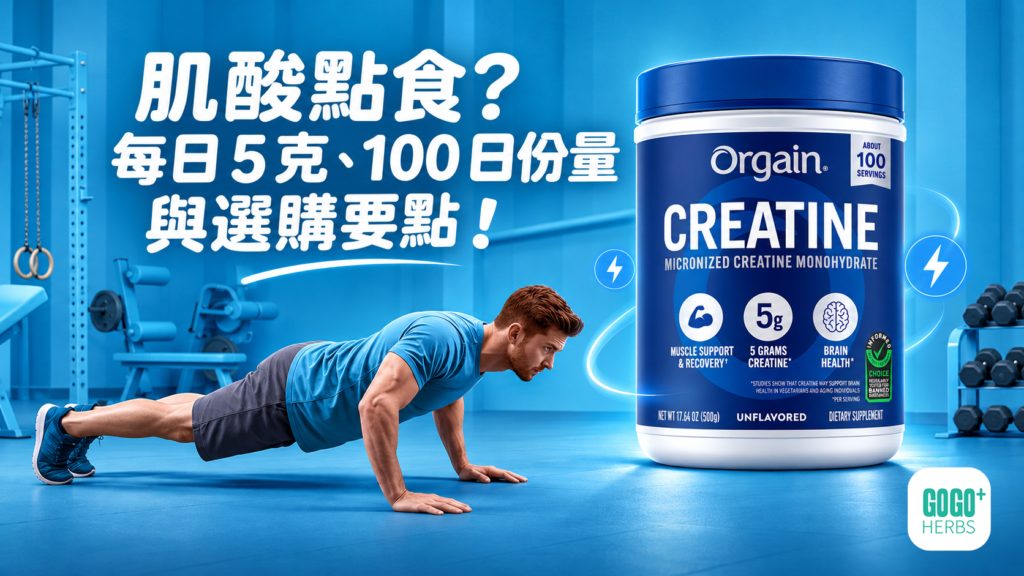
If I could only remember one thing:Take 3 to 5 grams of creatine monohydrate daily, every day, including rest days.That's enough. There's no need for a 20-gram loading period, no need to buy special formulations that cost several times more, and no need to "take it for a few months and then stop for a month."
Creatine is the most thoroughly researched supplement in the field of sports nutrition, with over 500 clinical studies. However, precisely because of the extensive research and large market, a lot of misleading claims have also emerged—some say a loading period is necessary, some say the monohydrate form is poorly absorbed and you should buy creatine hydrochloride, and some say it can damage your kidneys, so you're afraid to get a blood test.
This article clarifies three things based on existing evidence: how to calculate dosage, how to choose form, and what exactly the creatinine figure that worries many people is.
I. What is creatine, and why are vegetarians more prone to creatine deficiency?
Creatine is a nitrogenous compound that the human body naturally produces, synthesized by the liver and kidneys from arginine, glycine, and methionine.Approximately 95% is stored in skeletal muscle.The rest are distributed in tissues such as the brain.
Its role is at the very forefront of the energy system. The direct fuel used for muscle contraction is ATP (adenosine triphosphate), and ATP needs to be rapidly regenerated after it is depleted. ATP is stored in the muscles...creatine phosphateThe phosphate group can be returned to ADP, regenerating ATP in milliseconds—the primary energy source for high-intensity movements (weightlifting, sprinting, jumping) lasting 0 to 15 seconds.
The purpose of creatine supplementation is to further increase this reserve. Studies show that muscle phosphocreatine reserves can be increased by approximately 20%.
The main food sources are red meat and fish, containing approximately 3 to 5 grams per 100 grams. Herein lies a practical difference:If you don't eat red meat and fish, your food intake will be significantly lower.A 2026 observational study that tracked 8,407 people with special diets found that this group consumed an average of only about 0.82 grams of creatine per day, with 69.5% of them being under-consuming.
Therefore, for vegetarians, creatine is more about "filling dietary gaps" rather than "additional supplementation." Creatine supplements are chemically synthesized, not derived from animals, and are available to vegetarians.
II. 3 to 5 grams daily: The loading period is for acceleration, not necessary.
The International Society for Sports Nutrition (ISSN) 2017 position statement outlines two approaches:
| practice | dose | Time required to reach saturation | Who is it suitable for? |
|---|---|---|---|
| Direct maintenance period | 3 to 5 grams daily | Approximately 3 to 4 weeks | Most people who train for a long time |
| First, do the load period | Take approximately 20 grams daily, divided into 4 doses, for 5 to 7 consecutive days, then reduce to 3 to 5 grams. | About 1 week | People with clear time pressure |
The key is:Both roads eventually lead to the same place.The loading period simply compresses the time from four weeks to one week; it doesn't improve the final effect. Swallowing 20 grams at once most commonly results in bloating or discomfort—this can be reduced by dividing it into four 5-gram doses with meals.
If you don't have a competition or testing deadline, taking 5 grams daily is simpler and less likely to cause gastrointestinal problems.
As for "how much to eat," you can roughly calculate it using your body weight: approximately 0.03 grams per kilogram of body weight. A 60-kilogram person would consume about 2 grams, and a 110-kilogram athlete would consume about 3.5 grams—so 5 grams is more than enough for most people. Any excess beyond 5 grams will be excreted, and eating more is not beneficial.
Two other frequently asked details:Eat even on your day off(What determines the effect is muscle saturation, not the distance from the training.)No need for cyclic deactivation(Current research does not support the practice of "taking it for a few months and then stopping for a month"). As for concerns about caffeine, they stem from a single study in 1996, which has not been supported by subsequent studies.
III. Monohydrate and Other Forms: What You Get for Several Times the Price
This is the section you should spend five minutes reading when making your purchase. There are five or six forms of creatine on the market, with prices varying by up to five times, but the differences in research background are far greater than the price differences.
| form | Number of studies | relative price | Actual situation |
|---|---|---|---|
| Monohydrate(Monohydrate) | More than 500 items | benchmark | According to research standards, the oral absorption rate is approximately 99%. |
| Micronized monohydrate | Tongzuo | Slightly higher | The particles are finer and dissolve more easily, but the ingredients are the same. |
| Creatine hydrochloride (HCl) | fewer than 10 items | 2 to 5 times | High solubility, but there is no evidence that it is better absorbed by muscles. |
| Ethyl ester creatine | Approximately 5 items | 2 to 4 times | Studies show that a large amount is converted into creatinine before reaching the muscle.It performed worse than the monohydrate. |
| Buffered creatine (Kre-Alkalyn) | limited | 3 to 5 times | Using acid-base buffering as a selling point is problematic in itself. |
| Magnesium chelated creatine | Approximately 3 items | higher | Very little data |
The ISSN position statement directly names a common statement asMyths that have been refuted"The newer creatine formulation is more beneficial and has fewer side effects than the monohydrate form." The statement also noted that the monohydrate form is the most widely studied and clinically effective.
Why is this? Because the oral absorption rate of monohydrate is already close to 99%, leaving little room for further "better absorption." Gastrointestinal discomfort is mainly related to...Single doseIt's related to the form, not the method—taking 5 grams on an empty stomach at once can cause discomfort, but taking 2.5 grams twice with meals is usually fine, and doing so doesn't cost extra.
Therefore, the order of selection is simple:Monohydrate pure powder → Choose micronized powder if you find it difficult to dissolve → Choose the version with third-party certification if you are concerned about raw material purity verification.Unless you have a clear gastrointestinal intolerance and have tried reducing the amount or having it with meals and still feel uncomfortable, it's not worth paying the extra cost for other forms.
IV. What does it mean if the weight is 1 to 2 kilograms heavier than expected?
In the first one to two weeks after starting creatine supplementation, weight may increase by 1 to 2 kilograms. Many people stop at this point, thinking they are "gaining weight even from drinking water".
That weight is mainlyWater in muscle cellsIt's not fat. Creatine increases the osmotic pressure inside muscle cells, drawing water into the cells—this is one of its mechanisms of action, not a side effect.
Looking further ahead, a meta-analysis of 39 studies in 2026 indicated that with resistance training and an intervention period of 8 weeks or more, the average increase in fat-free body mass was approximately 3.39 kg. The same analysis also indicated that...Without resistance training, changes in body composition were not significant. In other words, creatine doesn't "build muscle immediately after eating it"; it amplifies the adaptations brought about by training.
If you're trying to lose fat, here's something you should know: a rise in the number on the scale doesn't mean you're back on track. What you should be looking at is your waist circumference, body fat percentage, and training record. Many people give up after seeing a rise in the weight in the first week, but they're misinterpreting that number.
5. Elevated creatinine levels do not necessarily indicate kidney damage, but it should be discussed before a blood test.
This is the most practical section of the entire text, and also the one that is least explained clearly by most people.
Creatine is broken down in the body to produceCreatineDoctors use serum creatinine to estimate kidney function (eGFR). Therefore, after creatinine supplementation, the creatinine level on the blood test report will rise slightly.
This riseThis reflects increased creatine metabolism, not kidney damage.Studies have directly verified this: creatine supplementation did not adversely affect glomerular filtration rate, a key indicator of kidney function. A systematic review and meta-analysis in 2025 also indicated that the increase in serum creatinine was minimal (approximately 0.07 µmol/L) and ceased to be significant after more than a week of supplementation.
However, there is a practical pitfall here:If you go for a kidney function test without telling your doctor that you are taking creatine, the number may be misread.
Therefore, before a physical examination or blood test, proactively mention that you are taking creatine supplements. This allows the doctor to use other indicators or adjust the interpretation method accordingly. This simple statement can save you unnecessary worry and even an unnecessary follow-up examination.
It should be emphasized that the above security information applies to...Normal kidney functionFor individuals with chronic kidney disease, renal insufficiency, or only one kidney, the additional creatinine load can complicate monitoring and should be assessed individually by a doctor, rather than starting on your own.
VI. Actual Calculations for this 500g Pack
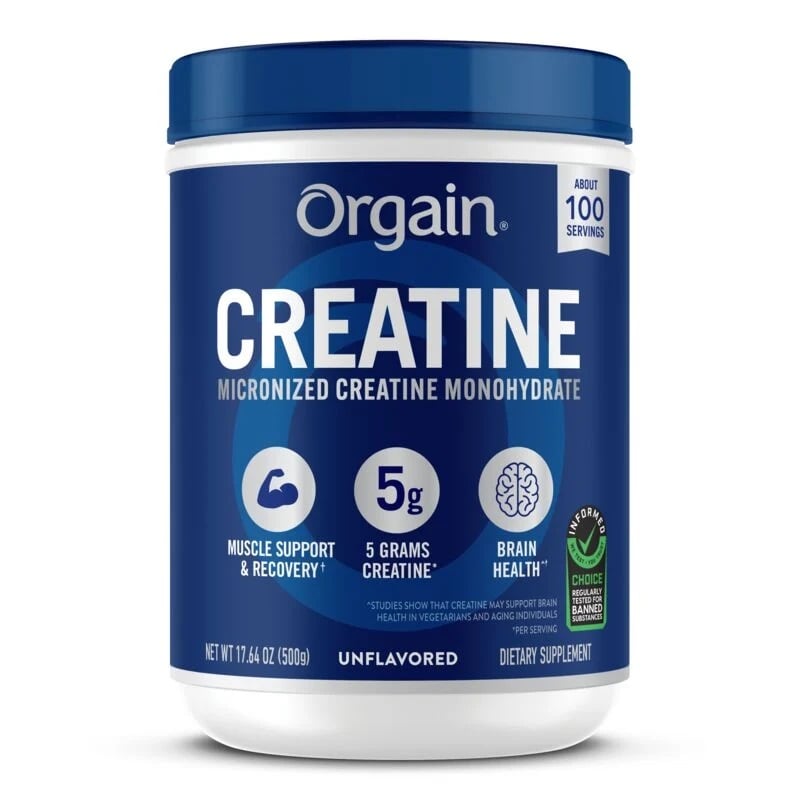
The following isOrgain Creatine Monohydrate Powder (Flavorless) 500gSpecifications, organized by product page and label:
| project | content |
|---|---|
| ingredient | Creatine monohydrate (single ingredient), 5 grams per spoon |
| Net weight / number of servings | 500 grams ÷ 5 grams = 100 copies |
| Suggested usage | Take 1 tablespoon (5 grams) daily, mixed with 240 ml of water, juice, or smoothie. |
| Edible days | One spoonful daily for approximately 100 days |
| Additives | No additives, fillers, or preservatives; gluten-free, non-GMO, soy-free, and sugar-free. |
| vegetarian diet | Suitable for (creatine is chemically synthesized and not of animal origin). |
| Place of origin | United States of America |
| Validity period | July 2028 |
| limit | Users under the age of 18 are prohibited from using this product. |
Three noteworthy actual figures:
100 copies means 100 days.At 5 grams per day, one bottle lasts approximately three months. This dosage is consistent with the recommendation of "3 to 5 grams per day"—there is no need to buy a second bottle for the full duration.
It contains only one ingredient and has no flavoring.The advantage is that you don't need to consume extra sugar or flavorings at the same time, and you can add it to any drink; the downside is that it has no taste. If you are sensitive to taste, adding it to juice or smoothie is better than adding water.
The expiration date matches the consumption period.With a daily supply of 100 units and an expiration date of July 2028, there is plenty of time, and there will be no situation where the product cannot be used up.
Pay attention to the label information.Do not use if you are under 18 years of age.This is not a conservative approach—long-term safety data on creatine supplementation in adolescents are still insufficient, and some academic societies only recommend its use under appropriate supervision.
Additionally, if you are pregnant, breastfeeding, have a medical condition, or are taking other medications or supplements, the label requires you to consult your doctor before use. Please do not skip this sentence.
7. Who should ask the doctor first?
The safety data for creatine in healthy adults are quite comprehensive, but the following situations warrant evaluation before starting treatment:
- Under 18 years old — Do not use product labels explicitly stating this; insufficient long-term data.
- Kidney disease, renal insufficiency, or unilateral kidney Elevated creatinine levels complicate monitoring.
- Liver disease Creatine is synthesized and metabolized by the liver and kidneys.
- Pregnancy or breastfeeding — Lack of sufficient security data
- Taking prescription medication — Especially drugs that affect kidney function or electrolytes
- Having a chronic illness and regular follow-up visits — Any new supplements should be disclosed to the attending physician.
These situations are not "absolutely not allowed," but rather require individual assessment. The difference lies in this: if a healthy person starts consuming these products on their own, the risk is very low; however, if someone with any of the above-mentioned conditions starts consuming them on their own, it may render the original monitoring inaccurate.
Finally, a reminder about expectations: creatine is not a substitute for training. All the body composition changes mentioned above are based on...Combined with resistance trainingOn the premise that... Without training, it won't build muscle for you.
VIII. Frequently Asked Questions
1. Is a loading period always necessary for creatine?
No. A loading phase (approximately 20 grams daily, divided into 4 doses, for 5 to 7 consecutive days) simply compresses the time it takes for muscles to reach saturation from approximately 3 to 4 weeks to approximately 1 week, achieving the same final result. A direct daily intake of 3 to 5 grams can also achieve saturation with less gastrointestinal discomfort. Loading phases are only meaningful if you have a specific deadline for a competition or test.
2. Is the monohydrate really worse than creatine hydrochloride and ethyl ester?
Conversely, the monohydrate form is supported by over 500 studies, with an oral absorption rate of approximately 99%; creatine hydrochloride has fewer than 10 studies, and ethyl creatine ester about 5, with the latter showing a higher conversion rate to creatinine before reaching muscle, making it less effective than the monohydrate form. The International Society of Sports Nutrition's position statement also lists the claim that "the new form is better than the monohydrate" as a refuted argument. A price several times higher does not necessarily equate to better results.
3. Will creatine damage my kidneys?
For individuals with normal kidney function, current research has not shown that regular doses cause kidney damage. A point of confusion is serum creatinine—a product of creatine metabolism. Creatine supplementation will cause a slight increase in levels, but this reflects increased metabolism, not kidney damage. Studies have directly examined glomerular filtration rate and found no adverse effects. However, if you have pre-existing kidney disease or are planning to have your kidney function tested, you should inform your doctor first.
4. Why did my weight increase after taking creatine?
The 1-2 kg weight loss in the first one to two weeks is mainly water within muscle cells, not fat. Creatine increases the osmotic pressure of muscle cells, drawing water into them; this is its mechanism of action. When assessing progress, look at waist circumference, body fat percentage, and training records, not just the weight in pounds.
5. Do I need to eat on my days off? What if I forget to eat one day?
Yes, it's necessary. The effectiveness is determined by muscle creatine saturation, not the time interval between training sessions, so you should take it as usual on rest days. If you miss a day, you don't need to double the dosage; just continue as usual the next day.
6. Do vegetarians need to supplement with creatine?
Worth considering. The main food sources of creatine are red meat and fish, and vegetarians typically have significantly lower intake levels – a 2026 observational study found that specific dietary groups consumed an average of only about 0.82 grams per day, with nearly 70% being insufficient. Creatine supplements are chemically synthesized and not derived from animal sources, making them suitable for vegetarians.
7. Can it be eaten with coffee or tea?
Yes, it's possible. The claim that "caffeine counteracts creatine" originates from a single study in 1996, and subsequent studies have not supported this conclusion. Creatine can be added to water, juice, smoothies, or electrolyte drinks; taking it with beverages containing carbohydrates and protein may slightly help with muscle retention, but the difference is minimal. The key is to consume it at consistent times each day, rather than at precise times.
References and Declarations
Main source:
- International Society for Sports Nutrition (ISSN) Position Statement:Creatine supplementation and exercise
- Product Information:Orgain Creatine Monohydrate Powder (Flavorless) 500gProduct page and packaging labels
statement:This article is a compilation of sports nutrition information and does not constitute medical advice, diagnosis, or treatment. Dosage and usage mentioned are based on publicly available research and product labels; individual needs may vary. If you have kidney or liver disease, are under 18 years of age, are pregnant or breastfeeding, or are taking prescription medications, please consult your doctor or registered dietitian before starting any supplements. The products mentioned in this article are nutritional supplements, not registered under the Pharmacy and Poisons Ordinance or the Chinese Medicine Ordinance, and are not intended to diagnose, treat, or prevent any disease. Product prices, availability, and expiration dates are subject to change and can be found on the product page and label.
Related Products:
-
Sale!

GINAX – Ginseng Tea Bag / Ginseng White Tea Rose Tea Bag | 1bag
Original price was: $13.00.$10.00Current price is: $10.00. 選擇規格 This product has multiple variants. The options may be chosen on the product page -
Sale!

GINAX – Manuka Honey UMF™ 5+ 30g
Original price was: $30.00.$25.00Current price is: $25.00. Add to basket -
Sale!
Single 10% off】aXimed – Recovery Speed 100% Whey Protein Powder 30 sachets
Original price was: $558.00.$502.00Current price is: $502.00. Add to basket -
Sale!
Livinglean – Organic Dietary Mineral Powder 8g x 20 sachets
Original price was: $368.00.$298.00Current price is: $298.00. Add to basket
Related Post:
![網購保健品付款前,先核對這 8 件事]()
Before paying for health supplements online, check these 8 things first.
![葡萄糖胺軟骨素MSM點揀?食極都痛先檢查每日劑量]()
Glucosamine chondroitin MSM selection? Eating causes pain; first check the daily dosage.
![gogoherbs-mens-hair-cover]()
How to Choose Hair Care Supplements for Men? A Comparison of 8 Biotin, Saw Palmetto, and Collagen Products
![晨光下的健康早餐时光]()
From hair-nourishing gummies to collagen powder: Comparison of 8 best-selling beauty and health products and their formulas.